
Last Updated: October 26, 2026
You have a document in hand and a form that says it must be sworn, witnessed, or notarized. Now you are stuck on one question: do you need a notary or a commissioner? The notary public vs commissioner of oaths question confuses many people in Ontario, and picking the wrong one can mean a rejected document, a missed deadline, or a second trip. If you need quick help, our Notary Public Services in Burlington cover both roles under one roof. This guide explains what each officer does, where their powers end, and which one fits your paperwork.
What is the Difference Between a Notary Public and a Commissioner of Oaths?
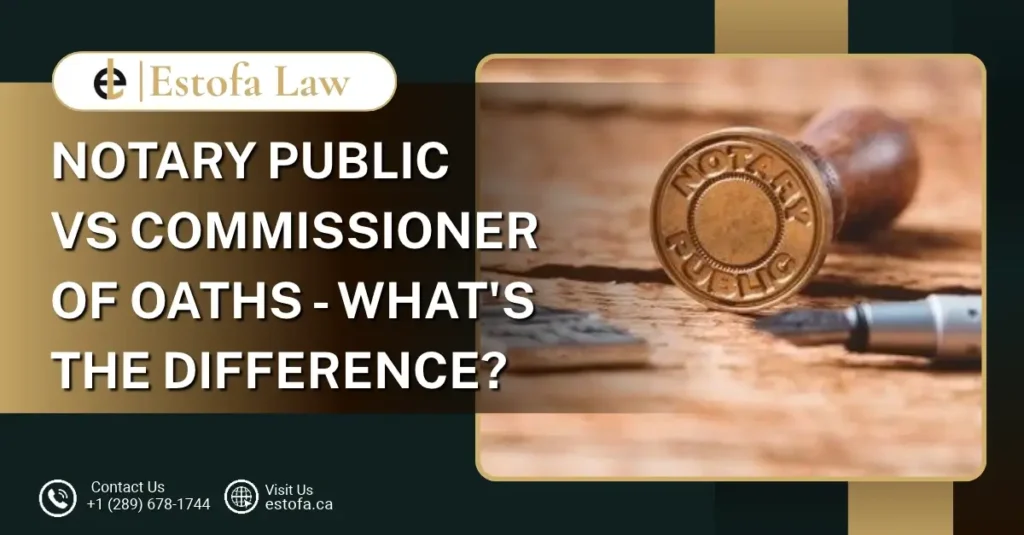
The short answer is scope. A commissioner of oaths can administer an oath and confirm that you swore or affirmed a document is true. A notary public can do all of that, plus certify copies, verify signatures, and prepare documents for use outside Ontario. In the commissioner of oaths vs notary public comparison, think of the commissioner as the narrower role and the notary as the wider one. Every notary in Ontario is also a commissioner, but not every commissioner is a notary.
Need a Document Sworn, Certified, or Notarized? Get It Done Right the First Time
Estofa Law offers walk-in and same day notary and commissioning services in Burlington. Bring your documents and valid photo ID, and we will take care of the rest.

What is a Commissioner of Oaths?
A commissioner of oaths, officially called a commissioner for taking affidavits in Ontario, is a person authorized to take oaths, affirmations, and declarations. Their main job is oath administration. You swear or affirm that the contents of a document are true, and the commissioner signs and stamps it to confirm you did so in front of them. This is common for affidavits, statutory declarations, and sworn statements used in court files, government applications, and insurance claims. A commissioner does not check whether your statement is true. They confirm your identity and that you made the oath. Their jurisdictional authority is also limited to oaths taken in Ontario.
What is a Notary Public?
A notary public is a public officer appointed by the province with broader powers. In Ontario, notaries are appointed under the Notaries Act, and most of them are lawyers. A notary can do everything a commissioner can do, and they also handle legal authentication tasks such as signature witnessing, certifying true copies of original documents, and attaching a notarial certificate that confirms a document was signed or verified properly. Because of this, notarized documents carry more weight with foreign governments, banks, and agencies. When a document needs formal document certification rather than a simple sworn statement, a notary is the officer you need.
Notary Public vs Commissioner of Oaths: Key Differences
Both are public officer roles, but the difference between notary and commissioner of oaths comes down to a few practical points. Each one affects whether your document will be accepted where you plan to send it.
Scope of Authority
A commissioner works with sworn and affirmed documents only. Their role starts and ends with affidavit verification and declarations. A notary covers that same ground and adds signature witnessing, notarial certificates, and copy certification. If your form only asks for a document to be sworn or declared before a commissioner, either officer will do. If it asks for a notary, a commissioner cannot step in.
Certified True Copies
This is where people most often go wrong. In the certified true copy notary vs commissioner debate, only a notary can confirm that a photocopy matches the original. Taking copies to the wrong officer is one of the most common notary mistakes we see, and it can send you back to square one. You might need a certified copy for a passport, degree, licence, or power of attorney you do not want to hand over. A commissioner’s stamp on a copy does not make it a certified true copy, and many agencies will reject it.

International Recognition
If your document is going outside Canada, you will almost always need a notary. Foreign governments, embassies, and courts look for a notary’s seal and signature as proof of legal authentication. Since Canada joined the Hague Apostille Convention in January 2024, many Ontario notarized documents can also be apostilled for use in member countries. A commissioner’s stamp rarely gets the same international recognition, so documents for overseas use should start with a notary.
Who Can Hold Each Role
In Ontario, every lawyer and licensed paralegal is a commissioner for taking affidavits by virtue of their licence. Some other public officials, such as municipal clerks, hold the role too. So, is every lawyer a notary public? No. A lawyer must apply to the province and be appointed as a notary before they can notarize documents. Most notaries in Ontario are lawyers, which is why many people book a law firm for both services.
Notary Public vs Commissioner for Taking Affidavits
You may see both terms on Ontario forms. “Commissioner for taking affidavits” is the official legal title in Ontario, while “commissioner of oaths” is the everyday name used across Canada. They describe the same role. So the notary public vs commissioner for taking affidavits comparison follows the same rules covered above: the commissioner handles oaths and declarations, and the notary handles those plus certification and authentication.
Which One Do You Need for Common Documents?
Most people only face this choice when a specific document is in front of them. Here is how the notary vs commissioner of oaths decision plays out for the paperwork we see most often in our Burlington office.
Travel Consent Letters
When a child travels without one or both parents, a consent letter is strongly recommended. The Government of Canada suggests having it signed in front of a witness who can administer oaths, such as a commissioner or a notary. In the notary vs commissioner for travel consent letter choice, a notary is the safer pick. Some border officers, airlines, and foreign countries expect a notarized letter, and a notary’s seal leaves less room for questions at the airport.
Power of Attorney
In Ontario, a power of attorney for property or personal care needs two qualified witnesses to be valid, not a notary or a commissioner. This is true whether you sign a durable or non-durable power of attorney, so the type you choose does not change the signing rules. Still, the notary public vs commissioner of oaths for power of attorney question matters in two situations. First, if your attorney will use the document abroad or with a foreign bank, a notarial certificate is often required. Second, if you need certified copies to give to banks or other institutions, only a notary can prepare them.
Affidavits and Statutory Declarations
For affidavits and statutory declarations used inside Ontario, a commissioner is usually enough. This covers things like name change declarations, proof of loss forms, and estate documents such as an affidavit of execution, which a witness swears when a will goes through probate. If your affidavit is tied to an estate, a Wills & Estate Lawyer Burlington can make sure the wording matches what the court expects. If the same affidavit will be used outside the province or country, have a notary handle it instead.
Can a Commissioner of Oaths Notarize Documents?
No. A commissioner of oaths cannot notarize documents, certify true copies, or issue a notarial certificate. Their stamp only confirms that an oath or declaration was taken. The reverse is different. If you wonder, can a notary public commission documents, the answer is yes. A notary holds commissioning power along with their notarial powers, so one visit covers both needs. When in doubt, a notary is the safer choice because they can handle whichever step your document requires.
Get the Right Officer the First Time
The notary public vs commissioner of oaths choice is simple once you know what your document needs. Sworn statements for use in Ontario can go to a commissioner. Certified copies, signature verification, and anything headed abroad belong with a notary. Before your appointment, read the instructions on your form, bring valid government issued photo ID, and do not sign anything until you are in front of the officer. Estofa Law offers walk-in and same day notary services, so you can get your legal documentation sworn, certified, or notarized in a single visit.
The information contained herein is intended for general informational purposes only and does not constitute legal advice. Since every situation and transaction carries its own distinct characteristics, it is strongly advisable to seek professional legal counsel tailored to your specific needs. Should any legal concerns arise, consulting a qualified lawyer is highly recommended.

Hassan Tahir
Barrister & Solicitor
Hassan Tahir shows strong legal skill and care for clients, with strong experience in real estate and immigration law along with a broad understanding of various legal matters. He provides clients with tailored answers, focusing on their needs first. Hassan values honesty, clarity, and great service, whether he’s handling residential or business property deal, or visa application cases.
Latest Blogs
-

First vs Second Mortgage – Ultimate Guide for Borrowers
• October 19, 2026 -
Title Company vs. Real Estate Lawyer: Who to Hire in Ontario?
• September 28, 2026 -
How do I Remove my Name from a Mortgage after Divorce in Ontario?
• September 22, 2026 -
Checklist for Private Lenders Before Closing a Deal
• September 15, 2026 -
How to Transfer Property Title from Parent to Child in Ontario
• September 7, 2026